Dallas Fort Worth International Airport handled nearly 88 million passengers in 2024 — third-busiest airport on the planet, spread across 26.9 square miles of North Texas prairie between Dallas and Fort Worth. That's bigger than Manhattan, and it shows. Five terminals.
Seven runways. Terminal parking at $32 a day per car. And DFW's multi-year International Parkway access project has been reshaping how vehicles reach each terminal — new right-hand exits into Terminals A, B, and C have opened, though Terminal C's own reconstruction project is separate and ongoing and can still mean shifted pickup and drop-off points with little notice.
For a solo traveler with a carry-on, navigating DFW is manageable. For a group, it's a different problem entirely.
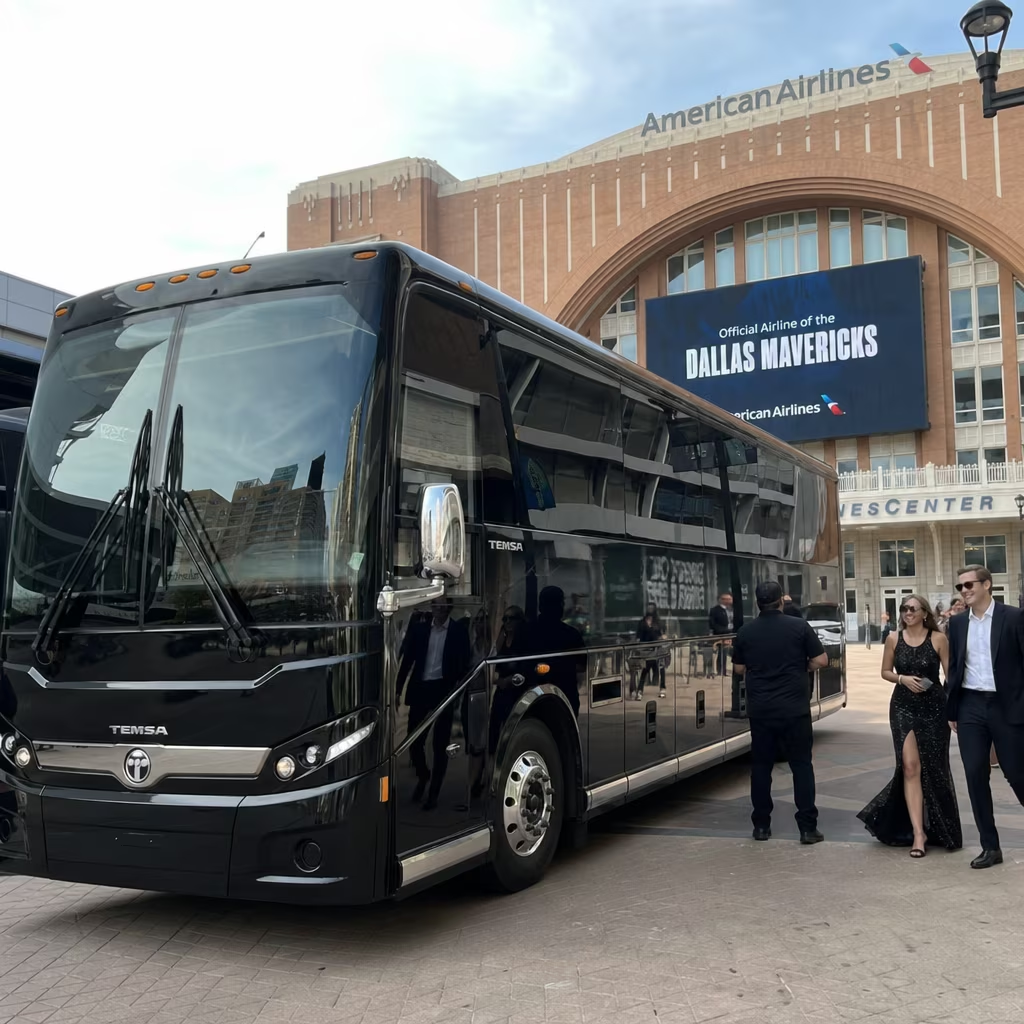
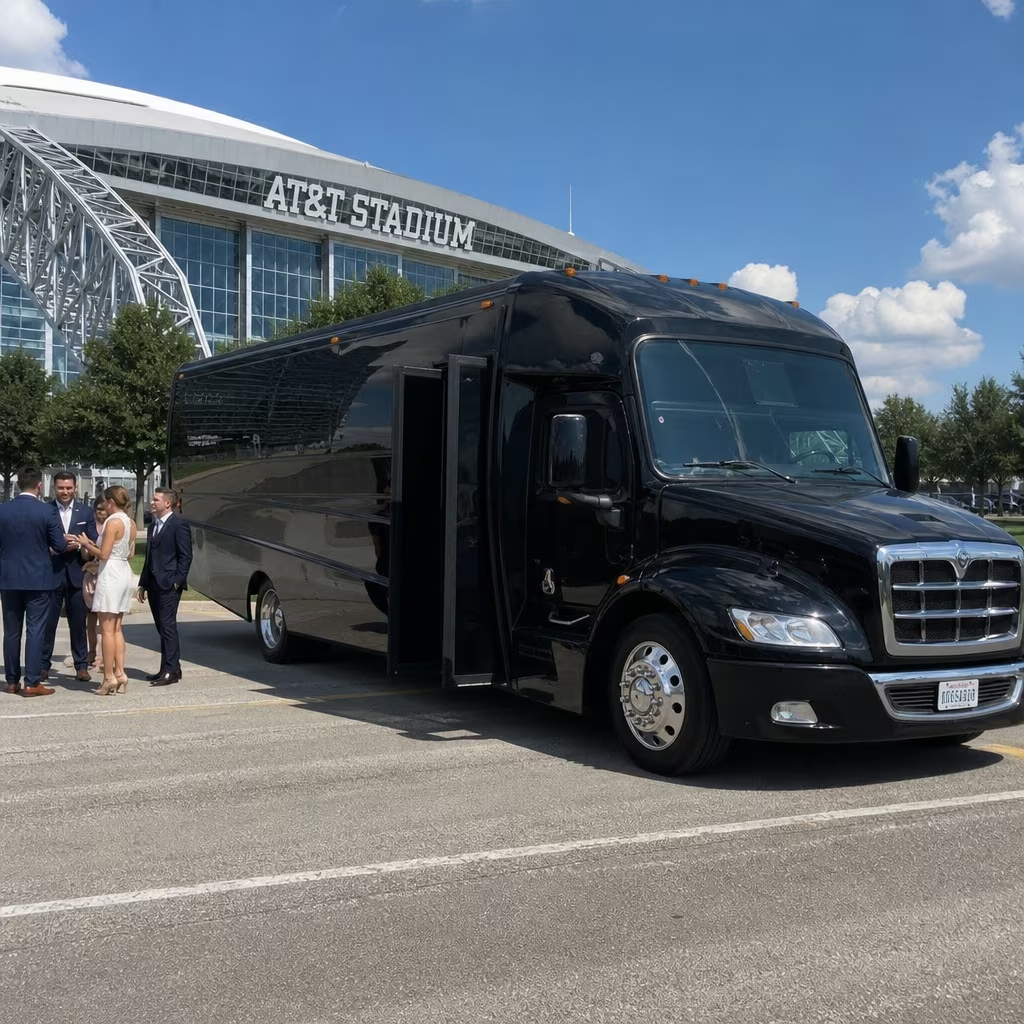
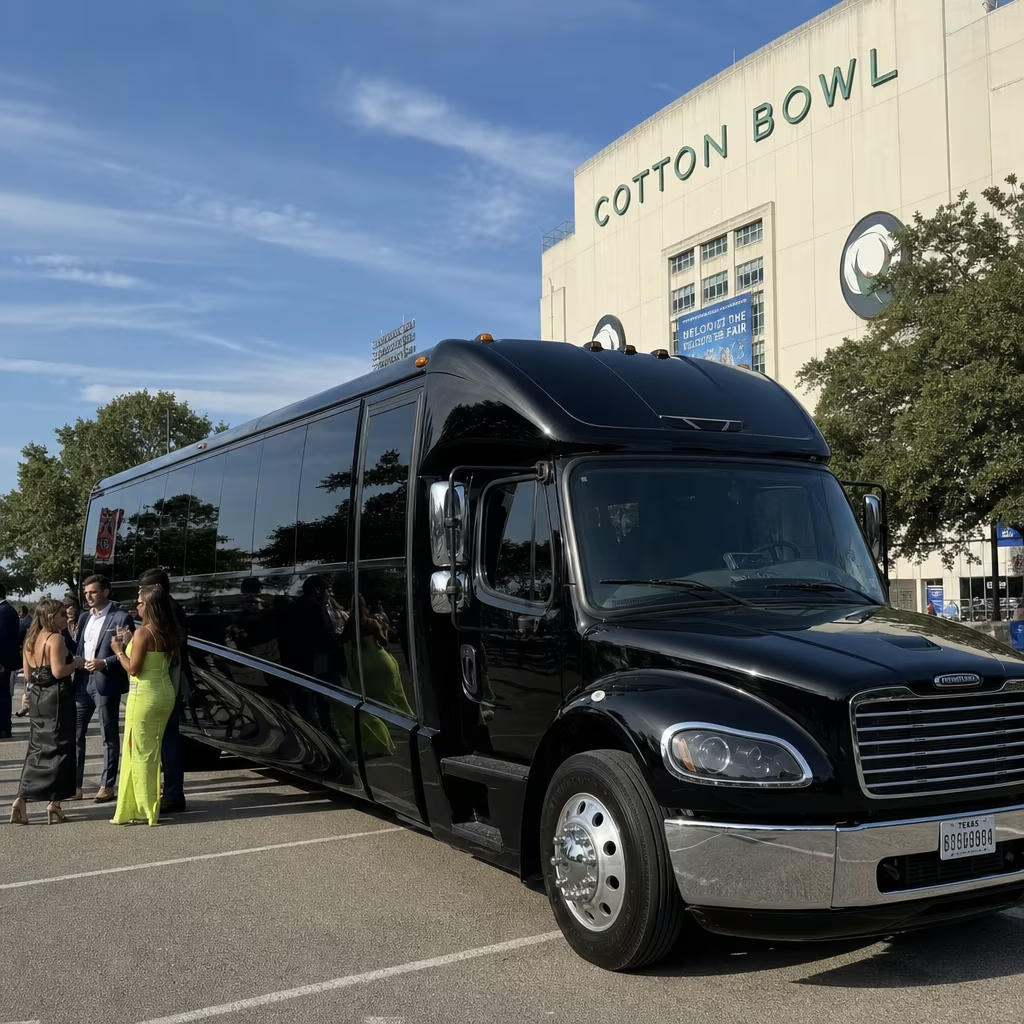
One Dallas charter bus or minibus to DFW changes the math completely. Your group loads at one address, rides to the right terminal curb, and on the return trip, a bus stages in a remote hold until everyone has their bags and is assembled at the arrivals door — then pulls in once, loads once, and leaves. No rideshare pool coordination across three terminals.
No $32-a-day parking bill multiplied by every car in the caravan. No person left standing at the wrong curb after a long flight. Below is everything a trip planner needs: exactly where the bus goes at each terminal, what the construction means for your approach, how parking costs stack up against a bus quote, and how to find the right vehicle through Dallaspartybuses.co.
Call 214-540-6746 any time to get pricing in under a minute.
Why a Charter Bus or Party Bus to DFW Beats the Caravan
The default group-to-airport plan for most people looks like this: everyone books their own rideshare, three cars arrive at three different times, one person goes to Terminal E when everyone else is at Terminal A, the pickup spot changes twice over text, and by the time the group is actually through security, 40 minutes of buffer time is gone. A Dallas charter bus rental eliminates every one of those steps. One vehicle, one pickup location, one curb at the right terminal — and on the return side, one staging plan so nobody stands guessing when their ride shows up.
For groups flying out together, the math is especially clear. Terminal parking at DFW runs $32 per car per day at the drive-up rate — and that's before a single bag is checked. A corporate team of 20 flying out for a five-day conference parks eight cars and spends $1,280 in parking alone.
A bus for the same 20 people on one quote, split across the group, often lands cheaper per head — and eliminates the morning scramble across SH 183 entirely. Dallaspartybuses.co shows pricing from the network of bus companies serving Dallas–Fort Worth in under a minute, no account required, through the online form or at 214-540-6746 any time.
The pickup workflow at DFW is the other reason groups prefer a bus. DFW's arrivals curbside has a no-dwell policy: any vehicle that arrives before the group is assembled gets moved along by airport police, adding a full loop that can run 20 minutes or more at a busy terminal. A charter bus handles this by staging in a remote holding area until the group coordinator signals that everyone has their luggage and is standing at the arrivals door.
Then the bus moves in once. One approach, one load, done. That workflow — gather first, then call — is the single most important thing a first-time DFW group planner should know before they land.
Charter Bus and Party Bus Drop-Off at DFW: Terminal by Terminal
Charter buses and commercial vehicles drop off and pick up at the lower-level curbside (arrivals level) of each terminal — A through E — using the commercial ground transportation lanes. For departures, have your group prepared to unload before the bus enters the terminal loop, because curb traffic flow at DFW is managed actively and vehicles cannot sit idle waiting for stragglers. For arrivals, meet at the lower-level curbside of your specific terminal after clearing baggage claim, and look for the ground transportation signage pointing toward the commercial vehicle lanes.
The official DFW ground transportation guide carries the current access status for each terminal's curb.
Terminal C remains the most active construction zone right now. DFW's multi-year Terminal C reconstruction and expansion project is currently active in the C28–C33 gate area, and ground transportation and shuttle stop locations near that section have shifted because of it. For groups arriving at Terminal C with flexibility, DFW's free Skylink people mover connects all five terminals airside — so passengers with carry-on luggage can ride from Terminal C to Terminal D or A, then meet the bus at the lower-level curbside of a less congested terminal.
Coordinate that plan before landing, and make sure everyone in the group knows the designated meeting terminal. For groups checking bags and needing to clear the Terminal C carousel, simply allow extra time at the curb, follow on-site signage or the airport's interactive terminal map for the current shuttle stop, and build a buffer into the pickup window.
For all terminals: designate one person as the group coordinator, have them watch the last bag come off the carousel, and send the signal for the bus only once everyone is assembled and standing outside on the arrivals level with luggage in hand. A bus that arrives to find the group still inside gets redirected by airport police — adding a re-loop that can take 20 minutes or longer during peak departure and arrival windows.
DFW Terminal Guide: Which Terminal Your Group Needs
DFW's five terminals — A, B, C, D, and E — are connected airside by the free Skylink automated people mover, which runs the full loop in roughly 15 minutes and operates 24 hours a day. Knowing which terminal your group flies from or arrives at tells you which lower-level curb the bus targets.
Terminals A, B, and C are American Airlines territory. Terminal A uses gates A8 through A39 and houses the DART Orange Line station on the lower level near Gate A10. Terminal B handles American Eagle regional operations at gates B1 through B49 and connects to the DART Silver Line station near Gate B43.
Terminal C covers American's domestic mainline at gates C2 through C39 — and is the most construction-affected terminal, with an active reconstruction phase in the C28–C33 gate area.
Terminal D handles international operations, including American's international departures and arrivals, along with several international carriers. Terminal E is where every other airline operates — Southwest, United, Delta, Spirit, and more. If your group includes travelers on different carriers, some may land at Terminal E while others arrive at an American terminal, which is exactly when having one bus pick up from one designated lower-level curb — and using Skylink or the Terminal Link landside shuttle to consolidate — saves 30 minutes of coordination chaos.
Once inside the secure zone, Skylink handles all inter-terminal movement. Landside, the Terminal Link shuttle connects terminals on the lower level for anyone outside security. For groups being picked up at DFW, the simplest plan is to pick a single meeting terminal in advance, communicate it to everyone before the flight, and let people use Skylink or Terminal Link to reach it after clearing baggage claim.
Terminals D and E tend to have more consistent lower-level curbside space than Terminal C during the current construction window.
International Parkway Construction: What Every Group Needs to Know Before Arriving
DFW has spent the past year reworking International Parkway, the main road connecting all five terminals, converting terminal access from left-hand to right-hand exits. New right-hand exits into Terminals A, B, and C have already opened, each with updated signage and routing. Terminal C's reconstruction and expansion project is a separate, longer effort with an active phase currently underway in the C28–C33 gate area, and it can still mean shifted ground transportation and shuttle stops with little notice.
Because these projects move in phases, check the official DFW construction page for the current status and any active lane closures or shuttle-stop changes before your travel date.
For a group charter bus, even a short-lived detour or a relocated commercial curb is more consequential than it sounds. A large commercial vehicle is slower through detours than a passenger car, cannot cut between lanes, and needs to reach a specific terminal curb on a specific schedule. The approach routes that Google Maps shows a car taking may not match the routes a 45-foot bus needs during an active construction phase.
Building a buffer into your pickup and drop-off schedule — not just into the highway drive — is the thing most first-time DFW group planners miss, especially around Terminal C while its reconstruction continues.
The practical advice for group departure day: if your group's flight is at 8 a.m., do not plan the bus for a 6:30 a.m. departure with the assumption that the drive from Dallas takes 30 minutes. Give your group two hours at the airport for domestic flights and three for international, add a buffer for possible construction-related delays or curb changes on top of your off-peak drive time, and you have a realistic departure window from your hotel or pickup location.
DFW Parking Costs vs. Renting a Charter Bus: A Practical Comparison
Terminal parking at DFW — the closest, most convenient lot — runs $32 per car per day at the drive-up rate, per the official DFW terminal parking page. Express parking (uncovered, Express North — Express South is closed as of September 2024 for construction) runs $18 per car per day; covered Express is $21 per day. Remote parking is $14 per car per day, with a free shuttle to every terminal running continuously.
Prebooking online can cut those drive-up rates significantly when booked well in advance. Cash is not accepted at any DFW parking facility — credit card or TollTag only at the exit plazas.
| Parking Type | Daily Rate (Drive-Up) | Best For | Current Status |
|---|---|---|---|
| Terminal | $32/day | Short trips, maximum convenience | Operational all terminals (C reduced) |
| Express North (uncovered) | $18/day | Mid-range convenience | Open; Express South closed since 9/9/24 |
| Express North (covered) | $21/day | Mid-range, weather protection | Open |
| Remote | $14/day | Long trips, budget-conscious | Open; free shuttle to every terminal |
| Cell Phone Lots | Free (2-hr max) | Waiting for an arriving passenger | North (53 spaces) and South (~60 spaces) |
Here is what that means for a real group scenario. A company of 30 employees flies out for a four-day offsite. If 10 of them drive separately and park in Terminal, that's $1,280 in parking before a single meal receipt is filed.
The same 30 people on one charter bus at a group quote, split across the headcount, typically comes in at a fraction of that per person — and eliminates the 10-car coordinated departure on SH 183 at 6 a.m. For a week-long trip, the comparison gets sharper: 10 cars in Terminal parking for seven days is $2,240 before fuel, before tolls on International Parkway, and before everyone has to designate their own ride home from an evening flight.
One piece of the parking picture worth knowing: DFW has two cell phone lots, free for up to two hours — the North lot (53 spaces, before the North toll plaza) and the South lot (approximately 60 spaces near Rental Car Drive and Southgate Avenue), per the official DFW cell phone lot page. They're a practical option for a car picking up one or two people. For a charter bus picking up a group of 25, the cell phone lot isn't the right tool — a commercial vehicle needs the curbside commercial lane, not a waiting spot, and the bus stages remotely until the group coordinator sends the signal.
Two entirely different workflows. Know which one your trip calls for.
The parking math on a week-long trip for 10 cars: Terminal parking at $32/day for seven days costs $2,240, not counting fuel or tolls. A single charter bus quote for the same group, split across 10 people (or more), frequently reverses that number entirely. Request an estimate in under a minute at 214-540-6746 and compare.
Rent a Bus to DFW: Routes, Drive Times, and the Approach From Dallas or Fort Worth
DFW sits roughly equidistant between downtown Dallas and downtown Fort Worth, straddling Irving and Grapevine. Three main highway corridors bring the Metroplex in. From the south and east, State Highway 183 is the primary approach from Dallas proper, Irving, and the mid-cities corridor.
From the north, State Highway 114 and Interstate 635 (LBJ Freeway) both feed into the airport's North plaza entrance. Once inside, International Parkway runs north to south past all five terminals. The official DFW directions page has direct Google Maps links from Dallas, Fort Worth, Denton, and Waco.
Off-peak drive times from common group pickup points:
| From… | Approx. distance | Off-peak drive time | Rush-hour estimate |
|---|---|---|---|
| Downtown Dallas | ~21 miles | 23–30 minutes | 45–70 minutes |
| Uptown / Midtown Dallas | ~22 miles | 25–35 minutes | 50–75 minutes |
| Downtown Fort Worth | ~24 miles | 26–35 minutes | 45–65 minutes |
| Irving (Las Colinas) | ~10 miles | 15–20 minutes | 25–40 minutes |
| Arlington | ~25 miles | 30–40 minutes | 50–70 minutes |
| Frisco / Plano | ~35 miles | 35–50 minutes | 55–80 minutes |
Those off-peak times double or worse during morning rush (7–9 a.m.) and evening rush (4–7 p.m.) on SH 183 and I-635 — the exact windows when most commercial flights land and depart from DFW. For a group charter bus picking up from a hotel in Uptown Dallas before a 9 a.m. flight, plan on a 6:00 a.m. departure time, not 7:30. Then add a buffer for possible construction-related delays once the bus enters the airport boundary, and you have the realistic window.
Any detour's impact compounds when traffic is heavy, particularly near Terminal C while its reconstruction continues.
DART Rail to DFW: What It Does and What It Doesn't Do for Groups
Two DART rail lines and a shuttle service connect DFW to the broader Metroplex — worth knowing even if you're planning a charter bus, since some members of a large group may ask about the train.
The Orange Line (DART) stations at Terminal A, near Gate A10 on the lower level. It runs through downtown Dallas — West End, Akard, St. Paul, and Pearl/Arts District — and continues to Richardson and Plano during peak hours. The fare starts at $3.
The Silver Line (DART) stations at Terminal B, near Gate B43, and serves Cypress Waters, Carrollton, Addison, Richardson, and Plano — but not downtown Dallas. A third option, the TRE LINK shuttle, connects Terminal D to the Trinity Railway Express commuter rail for service to downtown Dallas (Union Station) and Fort Worth (Intermodal Transportation Center). Full schedules and current fares are on the DART DFW airport page.
For one or two travelers with carry-ons heading to a downtown Dallas hotel, the Orange Line is excellent — $3 and about 50 minutes from Terminal A. For a group of 20 with checked bags, varying destinations across the Metroplex, a coordinated hotel arrival, and a hard schedule to keep — DART asks every member to manage their own bags on a crowded rail car, detrain at their own stop, and solve their own last-mile gap from the station to the hotel. A charter bus rental to DFW picks the whole group up at one curb and delivers them to one address. Both options get you from the airport.
Only one keeps everyone together on the same schedule. See the Dallas airport transportation page for a fuller comparison of DFW ground transportation options for group arrivals.
What Size Bus Does Your Group Need for a DFW Run?
Dallaspartybuses.co connects you to a range of vehicle types through a large network of bus companies serving Dallas–Fort Worth — so you're not limited to a single fleet or a single vehicle class. Here's how the vehicle lineup maps to common DFW group trips.
| Vehicle | Typical seats | Luggage capacity | Best DFW use case |
|---|---|---|---|
| 14-passenger Sprinter limo / Sprinter van | Up to 14 | Moderate — standard carry-ons, a few rollers | Executive team, small wedding party, VIP transfer |
| 15–35 passenger minibus | 15–35 | Overhead bins plus underfloor storage | Corporate teams, mid-size reunions, school groups |
| 40–56 passenger charter bus | Up to 56 | Excellent — deep undercarriage bays | Large corporate delegations, sports teams, tour groups |
For DFW airport runs specifically, luggage volume is usually the deciding factor — more so than headcount. A group of 18 business travelers each checking two bags for a week-long conference generates a luggage load that a minibus handles comfortably but a Sprinter van does not. A full-size charter bus with deep undercarriage bays is the right call whenever the group is large, the trip is long, or checked bag volume is high — everyone's luggage loads below, the cabin stays uncluttered, and there's no Tetris problem at the curb.
For smaller VIP airport transfers or a tight hotel-to-terminal run, a 14-passenger Sprinter limo or compact minibus gives the group a cleaner footprint inside the terminal loop. ADA-accessible vehicles are available through the network — flag it in your quote request.
Charter Bus and Party Bus Rental Prices for DFW Airport Trips
Pricing for a Dallas charter bus or party bus rental to DFW depends on your group size, vehicle type, total rental hours, and where the bus is picking up. To give you an idea of planning ranges: a minibus rental in Dallas for an airport transfer typically runs $200–$250 per hour on weekdays. A full-size charter bus for a larger group runs roughly $200–$350 per hour.
Sprinter van and limo hourly rates start around $200–$275 on weekdays. Per-day rates are available for groups with multi-leg itineraries or a complex pickup-and-delivery schedule involving multiple flights. These are planning ranges — the real quote moves with your exact date, your mileage, and vehicle availability in the network on your travel day.
The fastest way to get a quote for your trip is Dallaspartybuses.co's online form — pricing comes back in under a minute, no account required — or call 214-540-6746 any time of day. See the Dallas party bus prices page for a fuller breakdown of what different vehicle types cost across common DFW group trip lengths.
Picking Up Your Group at DFW: The Workflow That Makes It Smooth
Airport pickups at DFW go smoothest when the group coordinator runs the sequence rather than leaving it to chance. Three steps make the difference.
First, set the meeting terminal and meeting level before anyone boards the plane — not after they land. If the group is arriving on multiple flights at multiple terminals, designate a single lower-level curb at one terminal as the consolidation point. Skylink connects all five terminals airside in about 15 minutes per full loop, free, 24 hours a day.
Terminal Link shuttles connect terminals on the landside lower level for passengers outside the security perimeter. Pick one terminal, communicate it to everyone, and let those tools do the consolidation work.
Second — and this is the one that most groups get wrong — do not call for the bus until every member of the group has their luggage and is standing at the arrivals door. The bus stages in a remote hold at DFW until the coordinator signals readiness, then moves to the curb for a single load. A forced re-loop because the group wasn't ready when the bus arrived adds 20 minutes at a minimum, and more during peak periods on a busy arrivals level.
Get the full group together first. Then call.
Third, confirm your vehicle's luggage capacity against your actual bag count when you book — not at the curb. A 30-person group with one checked bag each is a different load than 20 people with two bags each. A full-size charter bus handles both without difficulty.
A minibus handles the first scenario comfortably and may need a bit more loading time with the second. Sort that detail at booking so there are no surprises at the arrivals door with a line of taxis behind you.
The DFW airport pickup rule: the bus stages remotely until the coordinator sends the signal. The signal goes out only after the last bag is collected and the last person is standing at the arrivals curb — not when most of the group is ready, not when you're almost at baggage claim, but when everyone is outside with everything. That single discipline keeps the operation to one approach, one load, and no forced re-loops.
Common Group Trips to and from DFW — and What Makes Each Different
Corporate conference transfers. A team of 30 flies into DFW for a multi-day meeting — half on American at Terminal C, half on United at Terminal E. They land within 90 minutes of each other. Without a plan, they're each booking their own rideshare into Dallas, arriving at the hotel over two hours, and charging the company for 30 separate fares.
With a minibus, the first group waits in the Terminal E lower-level area, the second group Skylinks from Terminal C and joins them, and one bus runs everyone to the hotel together. The Dallas corporate event transportation page covers recurring conference and team shuttle setups.
Wedding party airport pickup. Twelve members of a wedding party fly in from four cities on the Thursday before a Saturday ceremony — split across American, Southwest, and Delta, landing at Terminals A, E, and E again across three different windows. A 15-passenger party bus picks everyone up at one designated Terminal E lower-level curb after the last flight clears — the earlier arrivals use Skylink and Terminal Link to consolidate while they wait, nobody is standing outside longer than they need to be, and the whole group arrives at the hotel or venue together.
For the full weekend picture from hotel blocks to ceremony to reception, the Dallas wedding transportation page covers all of it.
Sports team departure. A college athletic program or club team — 45 players, coaches, and staff — is departing Terminal A for an away tournament. Each person has a roller bag and a gear duffel.
A full-size charter bus loads all 45 at one stop, runs straight to Terminal A's lower-level departure curb, and unloads in one organized wave instead of a 10-car caravan dropping athletes two at a time. The deep undercarriage bays hold every duffel without a single bag going in the cabin. See the Dallas group transportation services page for team travel packages and multi-leg itinerary options.
DFW vs. Dallas Love Field: Make Sure You're Going to the Right Airport
The Dallas metro is served by two airports, and confusing them costs you the trip. Dallas Love Field (DAL) is a smaller airport located about 6 miles northwest of downtown Dallas — primarily serving Southwest Airlines. If your group is flying Southwest, they're likely at Love Field, not DFW.
The two airports are about 18 miles apart and the logistics at each are completely different. The complete guide to bus and shuttle service to Love Field is at the Dallas Love Field airport bus guide. If your airline goes to DFW, this guide covers your trip.
If there's any question — especially for groups with mixed carriers — confirm the terminal airport with the airline before booking ground transportation.
Frequently Asked Questions About Charter Bus and Party Bus Rentals to DFW
Where does a charter bus drop off and pick up at DFW?
Charter buses and commercial vehicles use the lower-level (arrivals) curbside of each terminal — A through E — in the designated ground transportation lanes. For departures, the lower-level departure curb of your specific terminal is the drop-off point. For arrivals, the bus meets the group at the lower-level arrivals curb after baggage claim.
Because Terminal C's lower level is currently the most congested due to ongoing construction, groups with flexibility often coordinate to meet at a different terminal using Skylink or the Terminal Link landside shuttle. Check the official DFW ground transportation guide for current curb access conditions at each terminal before your travel day.
Can the bus wait for my group at the DFW arrivals curb?
No. DFW enforces a no-dwell policy at all terminal curbsides — airport police will redirect any commercial vehicle waiting without actively loading. The correct procedure is to have the group coordinator signal the bus only after everyone has their luggage and is standing at the arrivals door. The bus then moves in from its remote staging hold, loads once, and exits.
This is the standard commercial vehicle workflow at DFW. It runs smoothly when the group is fully assembled before the call goes out.
How much does parking cost at DFW?
At the drive-up rate: Terminal parking is $32 per car per day, Express North is $18/day uncovered or $21/day covered (Express South is closed as of September 2024), and Remote parking is $14/day with a free shuttle to every terminal. Cash is not accepted at any DFW parking exit — credit card or TollTag only. Prebooking online can significantly reduce drive-up rates when reserved in advance.
Full current rates at the DFW terminal parking page and express parking page.
How does the International Parkway construction affect charter buses?
DFW's International Parkway project has already brought new right-hand exits online for Terminals A, B, and C. Terminal C's separate, longer-running reconstruction project — currently active in the C28–C33 gate area — is the bigger factor for groups right now, since pickup and shuttle stop locations there can shift with little notice. For a charter bus, which is larger and slower through any detour than a passenger car, building in a buffer is still worth it, especially during peak departure and arrival windows. Check the official DFW construction page for the current status before your travel date.
Which terminal is American Airlines at DFW?
American Airlines operates from Terminals A, B, and C. Terminal A covers gates A8 through A39 (mainline American). Terminal B handles American Eagle regional flights at gates B1 through B49.
Terminal C covers domestic mainline at gates C2 through C39. International American Airlines flights depart and arrive from Terminal D. All other carriers — Southwest, United, Delta, Spirit, and others — are at Terminal E.
Check your boarding pass for the specific terminal assignment before your travel day.
How much does a charter bus to DFW cost?
To give you an idea: a minibus rental in Dallas for an airport run typically ranges $200–$250 per hour on weekdays; a full-size charter bus runs roughly $200–$350 per hour. The real quote depends on your group size, vehicle type, total hours, and pickup location. Dallaspartybuses.co shows pricing in under a minute — no account needed. Call 214-540-6746 or use the online form.
See the Dallas party bus prices page for a fuller breakdown by vehicle type.
Can I take DART rail to DFW?
Yes. The Orange Line stops at Terminal A (near Gate A10) for downtown Dallas connections; the Silver Line stops at Terminal B (near Gate B43) for Carrollton, Addison, and Plano. The TRE LINK shuttle connects Terminal D to the Trinity Railway Express for Fort Worth and downtown Dallas (Union Station).
Fares start at $3. Full schedules at the DART DFW airport page. DART works well for solo travelers.
For groups with luggage, multiple pickup locations, and a coordinated arrival schedule, a charter bus or minibus rental keeps everyone on one schedule and one vehicle without transfers.
How far in advance should I book a charter bus to DFW?
For most trips, two to four weeks out gives you solid availability and competitive pricing. For holiday travel windows — Thanksgiving week, the days around Christmas and New Year's, spring break, and major Dallas events that drive citywide demand — book as early as your travel dates are confirmed. Peak windows pull from the same vehicle supply that serves concerts, corporate events, and sporting events across the entire metro, and the right-size coaches go first.
Call 214-540-6746 as soon as your group's travel dates are set.
Are the DFW cell phone lots an option for a charter bus to wait?
The cell phone lots — North (53 spaces, before the North toll plaza) and South (approximately 60 spaces near Rental Car Drive and Southgate Avenue), both free for up to two hours — are designed for passenger vehicles waiting for arriving travelers, not for commercial buses. A charter bus uses a remote commercial staging area and moves to the arrivals curb only once the group coordinator signals that everyone is assembled and ready. The cell phone lot and the charter bus workflow are two separate systems for two different situations; they aren't interchangeable at DFW's scale.
Book Your DFW Airport Charter Bus or Party Bus Today
Whether it's 14 executives in a Sprinter limo, a 30-person company team in a minibus, or a 50-person tour group in a full coach, Dallaspartybuses.co makes it easy to compare vehicles and get pricing from the network of bus companies serving Dallas–Fort Worth in under a minute. No account needed. No obligation.
Any time of day. Fill out the online form or call 214-540-6746 now — and get your group to DFW without the parking math, the rideshare split, or the construction-delay surprise.
Heading to a venue in Dallas before or after the flight? The Dallas group transportation services page covers hotel-to-venue shuttles, multi-stop itineraries, and everything that comes with moving a larger group across the Metroplex on the same trip.